Act I · The trace
Follow one historical name across three coordinates.
Start with the source record, then follow its candidate signal through affiliation countries and publication time. None of these coordinates proves what a work studies.
Loading the timeline…
Source and scope Historical metadata, not research counts
- Why this entity is in ARCHE
- Seshat's recorded Europe-region rule
These are attributes of the historical source, not publication years or paper counts. The Europe selection does not assign modern territorial ownership or use historical geometry to classify scholarship.
Loading the research signal…
Two clocks · the past and the present
British Empire II: where it was, and where it is studied
Loading the map…
Act II · The pattern
Step back. Who carries this signal across Europe?
Compare country and institution patterns without confusing affiliation with expertise, ownership, or the historical place itself.
A · How it compares
How much is British Empire II studied, and when?
Loading the comparison…
B · Who studies it
Which institutions and countries study British Empire II?
Loading…
Act III · The record
Open the record. Test what the name can really show.
Inspect aliases, visible matches and individual works, then return to the source data and limits behind the view.
C · Can the matches be trusted?
What names find British Empire II, and what can be checked?
Loading…
D · Where it was, and where it is studied
Is British Empire II studied where it existed?
Loading…
E · Where to start
What to read first about British Empire II
Loading…
Research record
Sources, dates, licences and method
Everything needed to read this profile carefully: what the retrieval can show, where its records come from, and what remains open to inspection.
01 · Reading the signal
What this page can—and cannot—say
For each analysed country, ARCHE counts works whose title or abstract matched a label or alias of this entity and which record an institution in that country. These are leads for review, not findings about what a work studies.
An affiliation is not author nationality, historical ownership, proven expertise or the place where research happened. A zero does not prove that no research exists; a country not yet analysed remains unknown, not zero.
Cliopatria records territory for this entity well outside Europe (93% of its polygon vertices lie outside the frame of the Europe maps). The region shown for it, Western Europe, is the catalogue’s home region; countries beyond Europe are not part of the analysed affiliations.
02 · Data provenance
Which records were used?
Open the Cliopatria release → · Repository →
Cliopatria records a historical entity and its geometry. OpenAlex records scholarly metadata and institutional affiliations. A topic, an affiliation country and a historical territory answer different questions; ARCHE does not treat one as proof of another.
03 · Retrieval vocabulary
Which names were available to the query?
These names are metadata from Seshat/Cliopatria. They are not all used in the European retrieval, and a broad or shared name cannot automatically identify this historical phase.
- (British Empire) · also used by 1 other entity
- British Africa
- British Cape Colony · also used by 1 other entity
- British Colonial Empire · also used by 1 other entity
- British East Africa
- British Empire · also used by 1 other entity
- British Gold Coast
- Cape Colony · also used by 1 other entity
- East Africa Protectorate
- Gold Coast (British colony)
- Great Britain · also used by 2 other entities
- Kingdom of Great Britain · also used by 1 other entity
- Scramble for Africa
- Trucial States · also used by 1 other entity
Shared names: (British Empire) (British Empire I); British Cape Colony (British Empire I); British Colonial Empire (British Empire I); British Empire (British Empire I); Cape Colony (British Empire I); Great Britain (British Empire I, England Tudor-Stuart); Kingdom of Great Britain (British Empire I); Trucial States (British Empire I). A candidate retrieved through one of these names may belong to another phase of the same polity.
04 · Illustration
Image source and licence
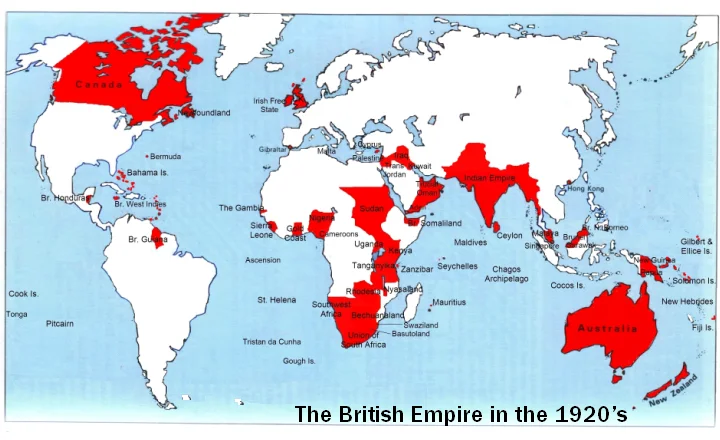
Map: Map of the British Empire in the 1920's.png · Ibu007 · CC BY-SA 4.0
Files come from Wikimedia Commons; retrieved 2026-10-25. The image was found by an exact-name search of Europeana and judged by an AI model; no person has reviewed it. Images illustrate the entity; they are not evidence about research, and a coat of arms or flag may postdate or only loosely represent the Seshat period.
05 · Open the underlying Seshat and Cliopatria record Tables, notes and references load only when you ask for them
Loading this entity’s source data…