Act I · The trace
Follow a name from an address into the archive.
Begin with the size of the corpus. Then move between institutional affiliation, publication time and recorded historical geometry—three coordinates that must not be mistaken for one another.
01 / Scope of this profile
A corpus under a lens.
Each line counts works, not historical entities. A catalogue-name match is a possible lead, not a reviewed finding.
- 01 / Starting corpus263History works with an institution in North Macedonia100% of starting corpus
- 02 / Catalogue-name candidates114Works matching at least one entity name43% of starting corpus
- 03 / Visible in the record15Works with at least one name in a title or abstract5.7% of corpus · 13% of candidates
The three lines use one scale: the starting corpus is 100%. Bar lengths show proportion; numbers show exact work counts.
Source & reading
OpenAlex Works API ↗ · History subfield · all publication years. Country means recorded institutional affiliation, not historical location.
History total retrieved 2026-10-11; candidate works retrieved 2026-10-11. Metadata licence: CC0 / public domain for OpenAlex metadata. Full method and limitations ↓
Related counts / different units
- Work–entity links
- 950 A work can match several entities (8.3 on average). Links are not additional works.
- Individual name matches visible
- 17 of 1,568 These count matches, not works. Other matches cannot be inspected in the title or abstract here.
More context from the saved profile
- 114 of the 263 History works with an institution in North Macedonia (43%) match at least one catalogue label; the other 149 match none, which does not mean they are unrelated, only that no label appeared in their title or abstract.
- 54% of these works were published in 2020 or later (publication year, not the period they discuss).
- The entity matched by the most works is Yugoslavia (43). A work matches 8.3 entities on average, so the 950 work-entity links are not 950 separate works.
- Ss. Cyril and Methodius University in Skopje has 59 of the 114 works (52%).
- Only 17 of the 1,568 matches (1.1%) can be seen in a title or abstract; 15 of the 114 works have at least one visible match. The rest were found by OpenAlex in text that ARCHE cannot show, so they cannot be checked here.
- 14 catalogue entities covered at least 10% of today's outline of North Macedonia at some time in Cliopatria; 13 of them appear among the matches from North Macedonia's institutions.
01 · Who studies what
From an institution to the names it studies.
Choose an institution, inspect its linked historical entities, then follow a candidate work. Map lines join source coordinates; they are not research journeys.
Territories show each entity’s widest recorded Cliopatria extent, not the place a work was written or a selected historical year. Explore historical time ↓
How to read this map · sources and limitations
A line joins an institution’s recorded main site to an entity’s approximate centre of widest recorded extent. It is neither a research journey nor a reviewed finding. It also does not say when the linked works were published.
Sources: OpenAlex candidate works (2026-10-11; OpenAlex records retrieved 2026-10-11; publication dates vary by work.; CC0 / public domain for OpenAlex metadata) and Seshat/Cliopatria historical extents (CC BY 4.0). Links are lexical candidates, not reviewed findings; mapped extents represent their widest source coverage.
Present-day reference map: OpenFreeMap vector tiles, derived from OpenStreetMap and OpenMapTiles. Last checked when this release was generated: 29 Oct 2026; live contextual cartography, not an ARCHE dataset or evidence layer. This map is drawn in Web Mercator because the base map is: areas toward the north look larger than in the Equal Earth maps of the Atlas and Explore. OpenStreetMap data are ODbL; visible attribution is retained here.
02 · What and when
Which entities are studied, and when?
- Select an entity (a row, or its name in the table) to see its own publication trace and which institutions study it.
- The bars above the columns count the country's unique candidate works per period; after you select an entity they show that entity only. The bars on the right are each entity's total.
- One work can match several entities, so rows must not be added to obtain the overall number of works.
- An empty cell means no candidate work was found, which is unknown rather than zero research; faded bars have fewer than five works and are not a trend.
- The coloured dot at the start of a row marks the era in which the entity existed; historical dates and descriptions are in the Entities explorer.
- Keyboard: Tab to the chart, up and down arrows move between entities, Enter selects, Escape clears. The Table button shows the same numbers as a table.
How to read this publication view · sources and limitations
Select a catalogue row to trace candidate publications over time. The chart counts North Macedonia-affiliated works; publication year is not the date when the entity existed.
Each row is a historical entity and each column a publication period; cell colour encodes candidate works. A work can occur in more than one entity row.
Source: OpenAlex Works API candidate works, retrieved 2026-10-11 · CC0 / public domain for OpenAlex metadata. Catalogue names and years: Seshat Global History Databank / Cliopatria · CC BY 4.0.
03 · Who held this land
Which historical polities covered today’s North Macedonia?
Over history, 14 states and empires had territory that included part of today’s North Macedonia.1 Works from North Macedonia’s institutions mention 13 of them; the other one appears in none.
Loading the territories…
1 Counted from a catalogue of 202 European polities. Territories as recorded in Cliopatria, the historical atlas of the Seshat project. “Included part of” means the territory overlapped today’s outline by at least 10%. More in method and limits.
How to read this territory view · sources, limitations and data table
Here the unit is a Cliopatria territory at a historical date, not the place where a paper was written. Compare it with the publication chart only as two different coordinates.
An entity is listed when one of its Cliopatria polygons covers at least 10% of today's outline of the country (Natural Earth Admin 0 Countries 1:50m, Cliopatria simplified geometry; intersection area measured in EPSG:6933 equal-area coordinates). This is orientation only: a polygon over a territory does not say who governed it, who lived there, or that any work studies it. The catalogue holds 202 Seshat/Cliopatria entities in Europe; polities that ruled this territory but are not in it do not appear.
This view is distinct from the map of institutions above. It describes territories recorded for catalogue entities at a selected historical year; it does not locate the research, assign the territory to North Macedonia, or prove that a candidate paper studies that place. Historical polygons are source coverage, not places where the works were produced. Colour shows when an entity began (old to recent).
Present-day reference map: OpenFreeMap vector tiles derived from OpenStreetMap and OpenMapTiles; last checked when this release was generated: 29 Oct 2026. It provides labels and current geography only, not ARCHE evidence. This map is drawn in Web Mercator because the base map is: areas toward the north look larger than in the Equal Earth maps of the Atlas and Explore. OpenStreetMap data are ODbL.
| Entity | Years covering it | Largest share of the outline | Candidate works from North Macedonia |
|---|---|---|---|
| Antigonid Dynasty | 291 BCE – 165 BCE | 100% | 1 |
| Bulgaria - Middle | 866 CE – 1017 CE | 100% | 14 |
| Byzantine Empire III | 1085 CE – 1205 CE | 100% | 26 |
| Late Roman Republic | 126 BCE – 32 BCE | 100% | 12 |
| Middle Roman Republic | 144 BCE – 127 BCE | 100% | 8 |
| Roman Empire - Principate | 30 BCE – 286 CE | 100% | 25 |
| Bulgaria - Early | 850 CE – 865 CE | 100% | 27 |
| Macedonian Empire | 326 BCE – 308 BCE | 100% | 25 |
| Grand Principality, Kingdom and Serbian Empire | 1220 CE – 1374 CE | 100% | 14 |
| Yugoslavia | 1946 CE – 1991 CE | 97% | 43 |
| Despotate of Epirus | 1220 CE – 1235 CE | 33% | none found |
| Avar Khaganate | 682 CE – 740 CE | 31% | 2 |
| Modern France I | 1918 CE – 1918 CE | 15% | 25 |
| Kingdom of Italy | 1941 CE – 1943 CE | 10% | 7 |
Act II · The pattern
Step back. What does the whole corpus suggest?
Compare country-wide candidate signals, then examine institutional concentration and the words that make some links visible. Different retrieval modes and dates limit comparisons.
04 · How it compares
What does North Macedonia look at, compared with the other countries?
Loading the comparison…
How to read this comparison · sources and limitations
Rates are candidate works per published country corpus, not a ranking of national expertise or historical interest. Country means OpenAlex institutional affiliation. Different retrieval dates and query modes can make country comparisons non-equivalent.
Source: versioned local OpenAlex Works API candidate partitions, with country-specific retrieval metadata. OpenAlex metadata: CC0 / public domain for OpenAlex metadata.
05 · Who and with whom
Who carries the work, and who is it like?
Loading…
How to read institutions and patterns · sources and limitations
Institution names and locations are OpenAlex affiliation records. They do not establish author nationality, where research happened, or institutional expertise. A work can have multiple institutions and match multiple entity names, so link counts are not additive.
Source: OpenAlex Works API candidate works, retrieved 2026-10-11 · CC0 / public domain for OpenAlex metadata.
06 · Limits of visibility
What this retrieval can—and cannot—make visible.
Loading…
How to read these limits · sources and limitations
A missing name match does not establish missing scholarship. The territory lens depends on recorded Cliopatria geometry; language and subject labels depend on OpenAlex metadata; open-access status is OpenAlex’s computed field. Each lens describes a limitation of retrieval visibility.
Sources: OpenAlex Works API · CC0 / public domain for OpenAlex metadata; Seshat Global History Databank / Cliopatria · CC BY 4.0.
Act III · The record
Leave the overview. Open a work.
A visible name lets you inspect why a work matched; it does not verify that the work studies the entity. Read the record, then return to the sources and limits.
07 · Where to start reading
Which works can you open and check yourself?
Loading…
How to read these entry points · sources and limitations
These works are selected to make a candidate match easier to inspect, not to rank scholarship or represent the full corpus. A visible name in a title or abstract still requires contextual review before it can be treated as research about an entity.
Source: OpenAlex Works API candidate works, retrieved 2026-10-11 · CC0 / public domain for OpenAlex metadata.
08 · The works
Read the works behind the numbers
114 works from North Macedonia’s institutions mention a historical entity by name. In 15 of them (13%) the name shows in the title or abstract, so you can check it yourself; in the others OpenAlex found it in text that is not shown here.
Loading the works…
| Work | Entity | Institution | Name found in |
|---|
How to read this, sources and limits
The saved works are the checkable end of this reading. Filter by an institution or entity above, then open a record to see the matched term and where it appears.
The list is the complete saved set, not a sample. Every link between a work and an entity is a candidate: nobody has checked it by hand, and a match on a name does not prove the work studies that entity. When OpenAlex finds the name in text that is not the title or abstract, it is shown as “Not shown”, never invented. Open a work to see the matching term, where it was found and the sources.
Comparability. The candidates for North Macedonia were retrieved on 11 Oct 2026 with search.exact. Countries were retrieved between 4 Oct 2026 and 28 Oct 2026. OpenAlex replaced its topic classifier in October 2026, so topic assignments of works retrieved before and after that change can differ. Counts should not be ranked across countries, or across entities retrieved with different modes, until a harmonised retrieval is published.
09 · Sources and method
Sources, dates, licences and method
Catalogue labels searched: 255 (Seshat/Cliopatria entity labels and aliases).
Sources, dates, licences and method
Bibliographic source: OpenAlex Works API · retrieved 2026-10-11 11:42:05 UTC · OpenAlex records retrieved 2026-10-11; publication dates vary by work. · licence: CC0 / public domain for OpenAlex metadata.
Historical entity authority: Seshat Global History Databank / Cliopatria · CC BY 4.0. Retrieval scope: MK research affiliations × Seshat historical Europe entity labels and aliases × OpenAlex History subfield.
Broad aliases left out: England, Rome, (Netherlands), Byzantium, Spain, СССР, Austria, Christendom, Cornwall, Finland, Gaul, Norway, Poland, Russia, Sweden, Switzerland, USSR, Vikings. These single words are also ordinary place names and return works about the place in general, so they are not counted; 13 works that matched only through them are excluded here. Works that also matched another label or alias of an entity stay. The raw pages are unchanged.
Method and limitation: candidate works are retrieved from OpenAlex and matched to Seshat/Cliopatria labels. These matches are not validated classifications or a measure of research attention; review of title, abstract, topics, and context remains necessary.
A retired pilot retrieval is a separate query cohort and is not substituted into these views.
Place registry: UNSD M49, local snapshot generated 2026-09-14. Place metadata and research evidence are separate datasets.
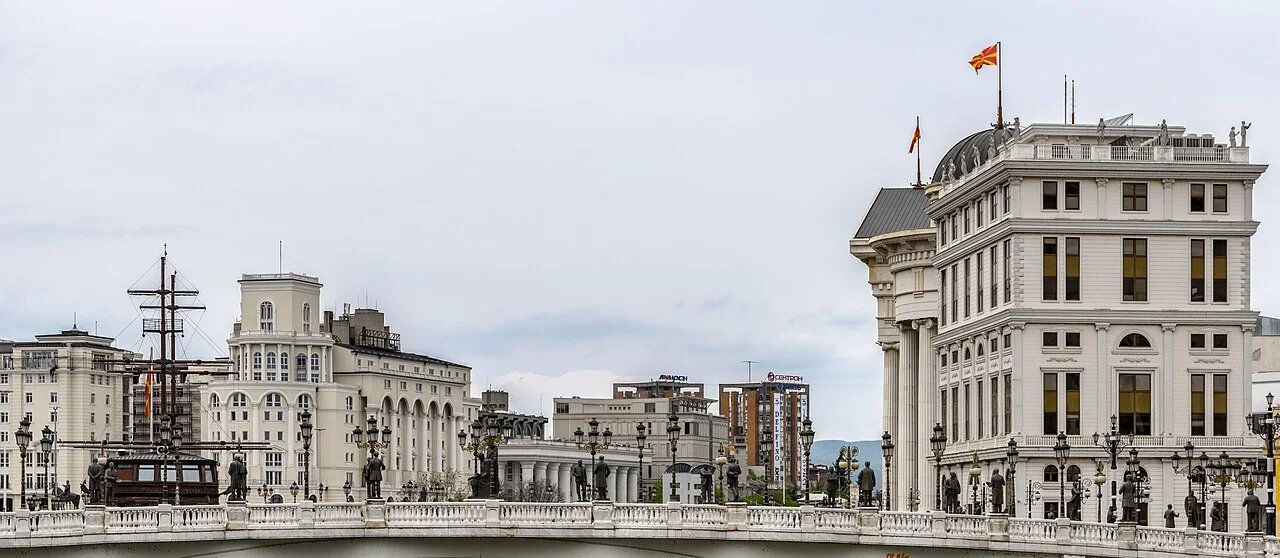
Representative image
Image: View of Skopje along the Vardar River, April 2026.jpg · Julian Lupyan / Wikimedia Commons · CC0
Representative place image approved in the local ARCHE backoffice. It is not evidence about the cultures studied. Retrieved 2026-10-25T14:52:13+00:00.
How to read this page. Country means the institutional affiliation recorded in OpenAlex, not author nationality, research location or historical territory. A lexical or topic match is a retrieval signal, not validated research attention.